Because I enjoy editing just as much as I enjoy writing, and because I want to do my small part to make the world of literature better, I’m offering first page critiques of unpublished stories. Submit your first page here!
This time, we have the first page of a 1283 word whimsical horror short story from Kelly C.
I’ll drop the first page for you to read, give my overall thoughts on what I think it’s accomplishing and where it implies the story is going, then I’ll include a few more specific comments below.
I include my assumptions for where I think the story is going because a first page always sets up reader expectations, and if the tone or vibe of a story is different than the expectations you set up on page one, you’re going to end up with a lot of dissatisfied readers. Especially in short stories, you’ll need the beginning of your story to be as strong and gripping and on theme as humanly possible.
So without further ado…
Hunger
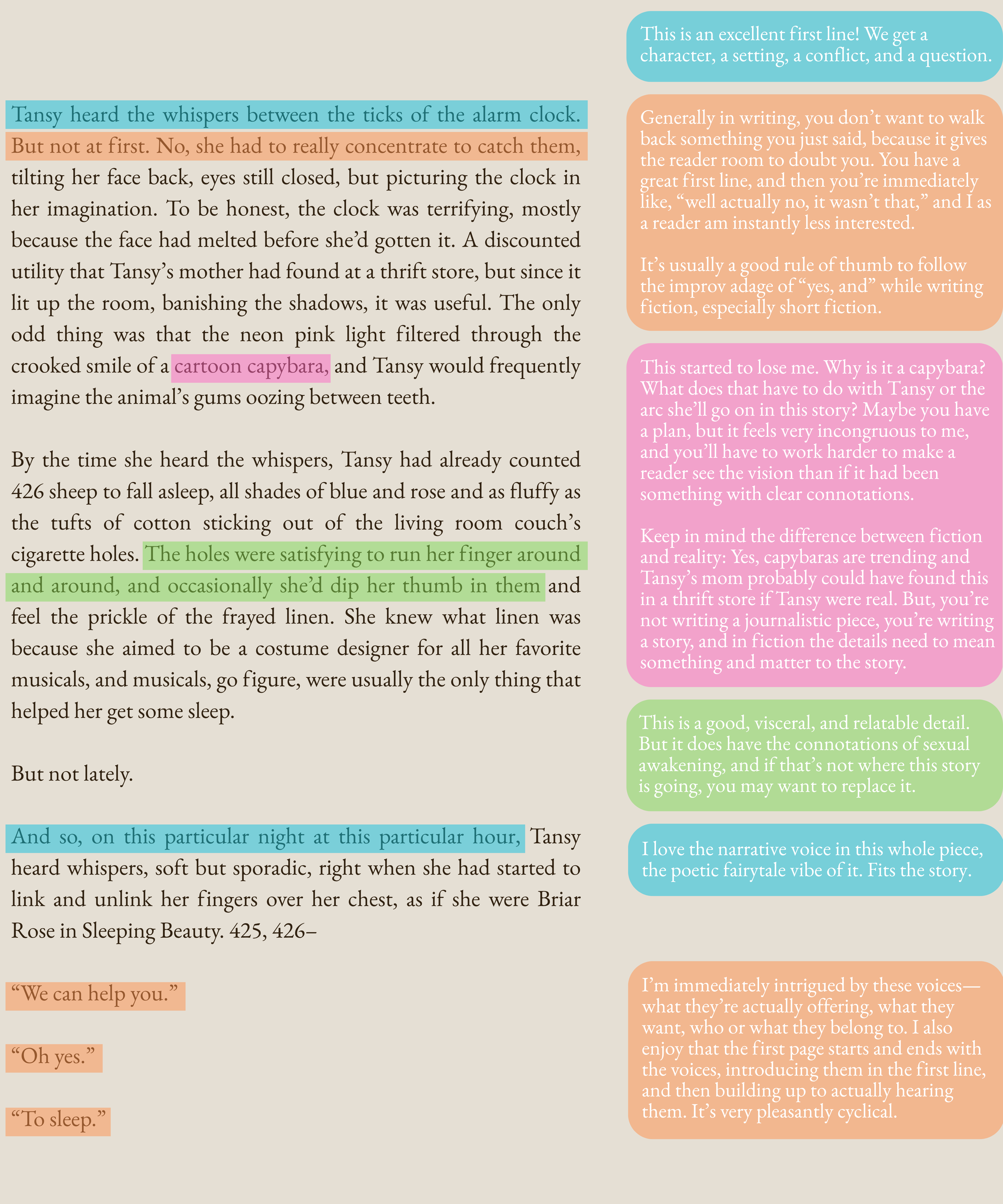
Tansy heard the whispers between the ticks of the alarm clock. But not at first. No, she had to really concentrate to catch them, tilting her face back, eyes still closed, but picturing the clock in her imagination. To be honest, the clock was terrifying, mostly because the face had melted before she’d gotten it. A discounted utility that Tansy’s mother had found at a thrift store, but since it lit up the room, banishing the shadows, it was useful. The only odd thing was that the neon pink light filtered through the crooked smile of a cartoon capybara, and Tansy would frequently imagine the animal’s gums oozing between teeth.
By the time she heard the whispers, Tansy had already counted 426 sheep to fall asleep, all shades of blue and rose and as fluffy as the tufts of cotton sticking out of the living room couch’s cigarette holes. The holes were satisfying to run her finger around and around, and occasionally she’d dip her thumb in them and feel the prickle of the frayed linen. She knew what linen was because she aimed to be a costume designer for all her favorite musicals, and musicals, go figure, were usually the only thing that helped her get some sleep.
But not lately.
And so, on this particular night at this particular hour, Tansy heard whispers, soft but sporadic, right when she had started to link and unlink her fingers over her chest, as if she were Briar Rose in Sleeping Beauty. 425, 426–
“We can help you.”
“Oh yes.”
“To sleep.”
My overall thoughts
Whimsical Horror is an interesting genre, and the struggle is of course balancing the creepy and horrific with the light and whimsical. When done well, the whimsy adds to the unsettled feeling while also keeping the story from being too horrific, especially when writing for children, like this piece seems to be doing. I’m assuming Tansy is in the 8–10 age range, based on the details of her room and the details included in the close third POV, though I’m not sure if this piece is for children or just about a child. I don’t know if that fully matters—the best kids stories can be enjoyed by adults too—but that would be something to keep in mind while editing this piece.
This piece does seem to balance the whimsy and horror well—I’m left feeling unsettled, but in a fantastical sense, rather than an “oh this girl is for sure going to die” sense, which I appreciate. More in the vein of a dark fairy tale than a slasher story. After reading this first page, I do want to know what happens next, which is what you want. I’m left wondering who or what the voices are, and how they’re going to affect Tansy’s life, or at least how they’re going to affect her night. The story of things whispering to a child in the dark isn’t necessarily new, but the specificity of detail and character in this piece make it feel fresh.
I don’t know for sure where this piece is going—a lot of things could follow this opening—but I’m definitely expecting Tansy to engage with the voices somehow. I’m also expecting this story to be some sort of metaphor regarding childhood and coming of age, whether it’s the traditional loss of innocence or something more specific. Given the details here and that this page is about a quarter of the story, I would probably guess that the story will be about Tansy coming to terms with or fighting against the fact that her family doesn’t have money and/or her mother isn’t the most involved parent.
One overall note I have is that while the details in this page are vivid and well-described, they do feel a bit random, like they were placed because they’re cool, not because they’re laddering up to something. In any piece, but a short story (bordering on flash fiction) especially, every detail has to be working together to communicate the same idea. In this page we have a pink capybara with a melted face that’s also a clock, bleeding gums, technicolor sheep, a couch with cigarette holes, costume design for musicals, and a fairytale reference. Those all could come together to tell a cohesive story, but I’m not seeing it yet. There are a lot of very different implications with those details.
But now for the specifics…
My Critique
That’s all I’ve got! This seems like an intriguing story, and I’m always here for fantastical coming-of-age stories. As you edit, keep in mind the deeper story you’re trying to tell—what is Tansy learning about herself or the world through these creepy voices? what is the reader learning about themself or the world through this story?—and then choose your details and descriptions based on what best communicates that story and those ideas. Thank you, Kelly, for sharing your first page, and I hope you found this helpful!
If you’d like a critique of your own first page, submit here.
Happy writing!

