Because I enjoy editing just as much as I enjoy writing, and because I want to do my small part to make the world of literature better, I’m offering first page critiques of unpublished stories. Submit your first page here!
Here we’ve got the first page of an approximately 87,000 word contemporary YA coming-of-age novel from a writer who wanted to remain anonymous.
I’ll drop the first page for you to read, give my overall thoughts on what I think it’s accomplishing and where it implies the story is going, then I’ll include a few more specific comments below.
I include my assumptions for where I think the story is going because a first page always sets up reader expectations, and if the tone or vibe of a story is different than the expectations you set up on page one, you’re going to end up with a lot of dissatisfied readers. There’s a little more room for forgiveness in novels, but it’s still hard to overcome a bad first impression.
So without further ado…
Mystic High
David Timbleton’s glasses slipped off the bridge his nose for the fourth time in as many hours. He huffed and pushed them back up with his middle finger, leaving an oil stain on the frame. Attaching the head was always the hardest part, and required the utmost concentration. People always thought that the arms and legs were the hardest—after all, they were the functional part of the robot, the part that made it “cool.” But David always had the most trouble with the head. An army of crooked-headed robots sat on a shelf, from most shoddy to least, with a few notable exceptions. His favorite exception was the one he had been building just before the freshman Spring Fling dance. It wasn’t functional—his date had sat on it—but he could never bring himself to scrap it or even repair it. He had had a date. This was proof.
He was soldering the last wire when his phone alerted him to a new message. And another. And another and another and anotheranotheranother. David sighed and set the robot on his desk. Corey Farris, his phone read, Party at my house tomorrow!!!
Melanie Kate: Be there!!!
Jillian Jacobs: Count me in!
Lillian McFaren: I’m there.
Jillian Jacobs: …nevermind. Fifteen other people contributed various positives responses. You didn’t really say no to Corey Farris.
A different message read, Paul Smith: dude you going?
David thought for a minute before typing out a response: Idk. Probably. Will Molly be there you think?
She was last week. She was introducing that insufferable British guy to people. Totally undaunted by the sheer number of people who just didn’t care.
My Overall Thoughts
So first and foremost, 87k is probably too long for a contemporary young adult novel. The sweet spot—if you’re looking to traditionally publish or you just want to fit in with people’s genre expectations—is between 50k and 70k, with a lot of debut books trending shorter for young people’s shortening attention spans. Which is not to say 87k won’t work, just that it’s something to consider as you edit.
Overall, I like the characterization happening on this page. David is a nerd, but in a relatable way, and we get some good interiority in the first paragraph and an engaging narrative voice. Given the sheer number of characters mentioned on this first page, I’m assuming we’re setting up for an ensemble cast, which is always fun. The eight names mentioned, though, sets off a few warning bells for me—I’ve seen ensemble casts go very wrong when they get too big and unwieldy. Character voices get lost, plot lines get repetitive and/or confused, stories get bogged down in unnecessary detail because there are more characters than good ideas. I’m hoping that won’t happen in this story, but from just this first page, I’m a little worried. Eight characters on the first page is too many characters here. I have nothing with which to tell them apart, so at this point their names (other than David’s) are meaningless to me.
A good POV-switching ensemble cast generally has three main POVs max, with maybe a few others sprinkled in when it’s necessary, all of them introduced slowly and distinctly enough that the reader has time to connect with and easily identify each character. Even if all these characters won’t be POV characters, it’s generally most effective to introduce one or two characters at a time with some sort of character trait that makes them unique and memorable. Otherwise a reader most likely won’t remember (or care) who’s who. That can sometimes be an intentional tactic, but considering these are David’s friends, that doesn’t seem to be the case here.
As far as plot, I’m not totally sure where this story is going. I would assume a love story between David and Molly, or just a love story for David in general, and probably some friend drama given the group text. It’s also possible Corey will experience some kind of hardship or fall from grace, but I’m more confident about the interpersonal dramas. It definitely feels like it’s setting up for a typical high school story: first loves, overwhelming schoolwork, friend breakups, big feelings, juggling responsibility, the big game and the science fair and the spring musical falling on the same day. That sort of thing.
The title Mystic High is tripping me up a bit, though. The title implies fantasy shenanigans, but the author simply called it a contemporary coming-of-age, and nothing on the first page implies fantasy. If it was just a mis-categorization and it is a contemporary fantasy, that’s awesome, and I’m very here for it. If it truly is just a contemporary novel, consider changing the name to something without fantasy implications.
And now for the specifics…
My Critique
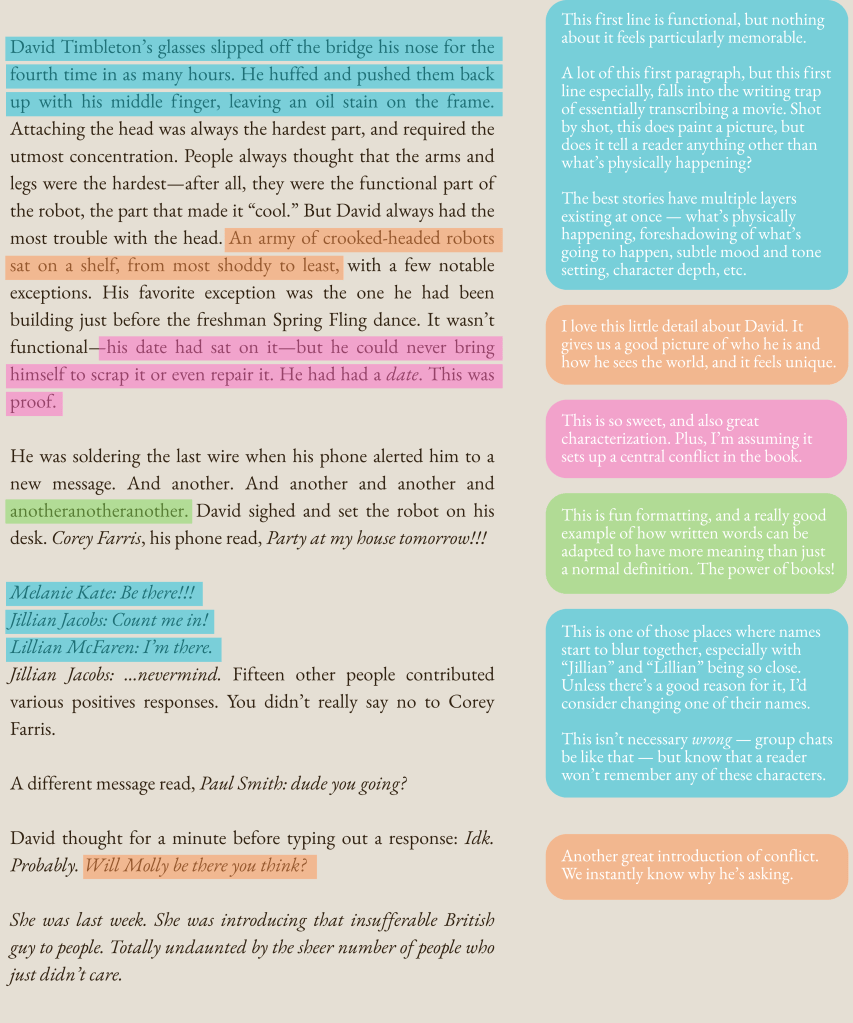
That’s all I’ve got! I love the ensemble set-up and think it’s a strong approach for a coming-of-age story. The characters seem fun, and I can’t wait to see how each of them become as real as David on the page. Thanks for sharing your first page, and I hope you found this helpful!
If you’d like a critique of your own first page, submit here.
Happy writing!
 Kristen Sommers